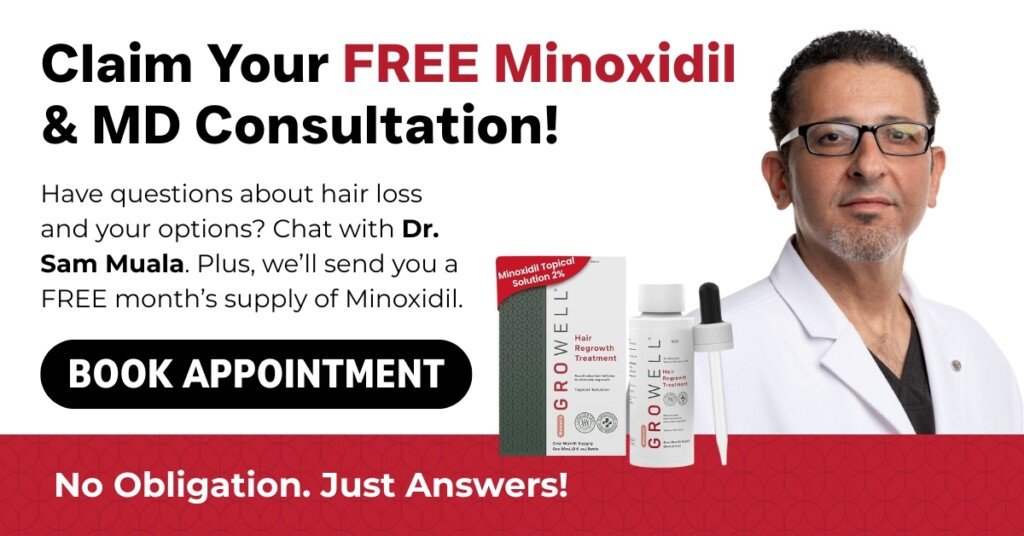


Understanding your hair loss treatment options is the first step toward taking control — but with so many approaches available, it can be hard to know where to start. To bring clarity, we spoke with Dr. Samer Muala, a hair restoration physician and founder of HimAndHair.com, who regularly guides patients through the full spectrum of treatments: from medications and in-office procedures to at-home therapies like red light therapy.
Below, Dr. Muala breaks down each option, explains the science, and shares who each treatment is and isn’t right for.
About Dr. Samer Muala, MD
Dr. Samer Muala is a board-certified physician specialising in hair restoration, based in Phoenix, Arizona. As founder of HimAndHair.com, he provides virtual consultations to patients across the US on hair loss treatment options including medications, LLLT, PRP, and combination therapies.
1. What are the most common causes of hair loss you see in patients?
The majority of patients I see are dealing with genetic hair loss (androgenetic alopecia) — the most common form, affecting roughly 85% of men and up to 50% of women at some point in their lives. Hormonal changes, stress, nutritional deficiencies, medical conditions, and certain medications can also contribute. Often, hair loss isn’t caused by just one factor, which is why treatment plans should be individualized.
2. What treatment options are available for people experiencing hair loss?
Patients generally have several categories of options:
Topical treatments — Minoxidil is the most widely used topical, FDA-approved for both men and women. It extends the growth phase of the hair cycle and is effective for many patients within 3–6 months.
Oral medications — Finasteride (for men) blocks DHT, the hormone that shrinks hair follicles in androgenetic alopecia. Oral minoxidil is also increasingly prescribed at low doses for both sexes.
Low-level light therapy (LLLT) / red light therapy — An FDA-cleared, drug-free option that stimulates follicles at the cellular level. Devices like the GroWell Cap are clinically tested for use at home.
PRP (Platelet-Rich Plasma) — An in-office procedure that uses concentrated growth factors from the patient’s own blood to stimulate follicle activity. Typically requires a series of sessions.
Hair transplantation — A surgical option (FUE or FUT) for patients with more advanced loss who want permanent, natural-looking results.
Each option carries its own benefits, risks, costs, and time commitment — which is why personalised guidance from a physician is essential.
3. Are medications always necessary?
Not always. Medications can be effective for some patients, but they aren’t right for everyone due to side effects, medical history, or personal preference. Medications like finasteride, for example, can cause side effects some patients are not comfortable with. Many seek non-drug alternatives, which is where red light therapy becomes an appealing option.
4. Where does red light therapy fit into the treatment landscape?
Red light therapy is a clinically proven, non-invasive option that can be used on its own or alongside other treatments. It works by photobiomodulation – stimulating hair follicles at the cellular level through specific red and near-infrared wavelengths, improving circulation and encouraging follicles to remain in — or return to — the growth phase.
5. Is red light therapy actually backed by science?
Yes. Low-level light therapy (LLLT) has been studied for years and is FDA-cleared for treating genetic hair loss in both men and women.
Clinical trials — including peer-reviewed studies published in Lasers in Surgery and Medicine — have demonstrated statistically significant improvements in hair count. When used correctly and consistently, it can support thicker, healthier hair growth over time.
6. Who is a good candidate for red light therapy?
Red light therapy is especially effective for patients in the early to moderate stages of hair thinning, but I also recommend it to patients who want to maintain results after other treatments. It’s a great option for people seeking something safe, drug-free, and easy to use at home.
7. Can red light therapy be combined with other treatments?
Absolutely. In fact, combination therapy is very common. Red light therapy often complements topical treatments, supplements, or medical procedures by supporting scalp health and follicle function.
8. How important is consistency with red light therapy?
Consistency is everything. Hair growth is slow, and follicles need repeated stimulation over time.
Most at-home devices — including the GroWell Cap — recommend sessions every other day or 3–4 times per week. Most disappointing outcomes I see come from patients who didn’t follow that schedule or stopped within the first two months, before results had time to develop.
9. What should patients realistically expect in terms of results?
This is not an overnight solution. Most patients notice early changes within three to four months, with more visible improvements around six months or longer. Clinical studies on FDA-cleared LLLT devices have shown an average 35–37% improvement in hair count after 16 weeks of consistent use — with some participants seeing results exceeding 90%. Red light therapy rewards patience and routine.
10. How does device quality affect results?
Device quality matters a great deal. Patients should look for FDA-cleared devices. The clinically validated wavelength range (typically 630–670nm for red light) and sufficient scalp coverage. Well-designed products, like the GroWell Cap, make it easier for patients to stay consistent, which directly impacts outcomes.
11. Can red light therapy replace a hair transplant?
Red light therapy doesn’t replace a transplant, but it can play an important role before or after one. It may help slow progression early on and is often used post-procedure to support healing and help preserve surrounding hair.
12. What’s your advice to someone just starting their hair loss journey?
Don’t wait, and don’t rely on guesswork. The earlier you act, the more options you have. Get educated, explore all your hair loss treatment options, and choose a plan you can realistically stick with. Hair loss treatment is about long-term commitment, not quick fixes — but with the right combination of treatments and consistency, meaningful results are absolutely achievable.
Final Thought
Hair loss is personal — and so is the right treatment plan. Navigating your hair loss treatment options is much easier with expert guidance. If you’d like a personalised assessment, Dr. Muala offers a free 15-minute medical hair loss consultation to help you understand your options and find the right path forward.