Why Combining Laser and LED Red Light Therapy Outshines Laser Alone for Hair Regrowth
Hair loss is a concern that affects millions of people, and red light therapy – also referred to as low-level light therapy (LLLT) – has emerged as a proven, non-invasive solution to stimulate hair regrowth. Traditionally, laser therapy has been thought to be the best option. However, in recent years, devices that combine laser diodes and LEDs (light-emitting diodes) have gained popularity — and for good reason.
With so many red light therapy hair growth products out there, it’s important to look at the differences between those that just use lasers and those that utilize a combination of laser and LED. Below we’ll explore why combining both technologies offers a more effective and comprehensive approach to hair restoration compared to laser alone.
How Red Light Therapy Works
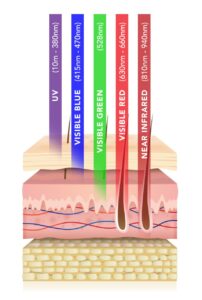
Red light therapy for hair growth involves exposing the scalp to low-level red light, with scientific studies indicating the most ideal being between 650 and 670nm.
This light is absorbed into the skin and energizes the mitochondria in hair follicle cells, increasing ATP production, improving blood flow, and prolonging the growth phase (anagen) of the hair cycle.
This process is well-documented to improve hair density, thickness, and scalp health.
“Consumers need to understand that it’s not about more power and the number of diodes … it’s about delivering the optimal dosage,” said Frank DeMartin, CEO of Apira Science, one of the original pioneers in the LLLT industry and maker of the popular GroWell caps. “Science shows that red light therapy works and does so with a very high success rate. There’s no disputing that, but not all products are created equal. We’re very proud that we offer the only hair growth cap that has been scientifically proven – in two peer reviewed and published studies – to be 100% effective.”
The Role of Lasers in Hair Regrowth
Lasers have historically been used in red light therapy devices because of their precision and ability to deliver concentrated light. Laser diodes emit coherent light, which travels in a focused beam making them an effective way to transfer higher energy to a small, specific area.
However, laser-only devices have some limitations:
The beam is very narrow and covers only specific points.
More lasers and careful positioning are needed to ensure complete and even coverage
They tend to treat only targeted areas rather than the whole scalp.
Why Add LEDs to the Mix?
LEDs, on the other hand, emit non-coherent, diffused light. While they’re not as intense or focused as lasers, they effectively bathe the entire scalp in light, covering a wider area more evenly.
Here’s what LEDs bring to the table:
Broad coverage of the scalp, including areas lasers might miss.
Gentle, diffused light that complements the high-focused intensity of the laser beams.
Reduced “hot spots” or uneven treatment common with laser-only devices.
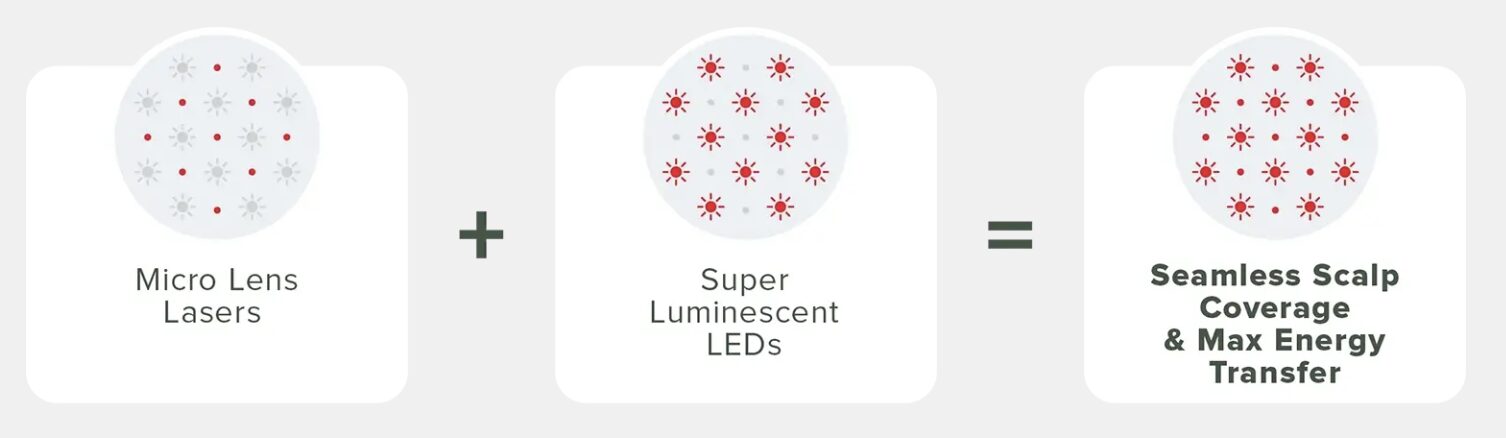
“In the end, more coverage means better results and more hair,” said DeMartin. “Some brands claim that their laser-only approach is the best, but in the end, real science and proven results simply don’t agree. Yes, laser-only can regrow hair, but we believe that our combination of proprietary, micro-lensed lasers and LEDs, delivered at the optimal dosage, offers both men and women the best opportunity for success. The scientific evidence is pretty clear, and we have 20 years of proven results to back that up.”
The Power of Combination Therapy
When lasers and LEDs are used together in the same device, they deliver the best of both worlds:
Concentrated Energy + Broader Dispersion — Lasers are directed to specific areas while LEDs deliver broader, less focused beams over the entire scalp.
Comprehensive Coverage — LEDs fill in the gaps that narrow laser beams might overlook.
More Uniform Results — Combining the two vastly improves efficiency and consistent treatment for better overall results.
Faster and More Noticeable Improvements — Studies and user experiences often report quicker and more significant hair density improvements when both technologies are combined.
Why Settle for Less?
While lasers alone can certainly help stimulate hair growth, the combination of lasers and LEDs ensures that both the deep follicle roots and the surrounding supportive tissues receive the benefits of red light therapy. This synergy leads to more robust, uniform, and natural-looking results.When choosing a red light therapy device, look for one that combines both laser and LED technology to maximize your investment and give your scalp the full, comprehensive care it deserves.Hair loss treatments have come a long way, and technology now allows us to use a dual approach that is convenient, safe and effective. Combining lasers and LEDs in red light therapy not only increases effectiveness but also enhances comfort, convenience, and coverage.So if you’re serious about restoring your hair and reclaiming your confidence, opt for a device that leverages the complementary strengths of both lasers and LEDs. Your hair — and your future self — will thank you by using laser and LED red light therapy for hair regrowth.
FAQ – Frequently Asked Questions About Using A Combination LED and Laser for Hair Regrowth
Does LED red light therapy work as well as lasers for hair growth?
LED red light therapy is effective for hair growth, particularly because it provides broad, even scalp coverage. When combined with lasers, LEDs help ensure more uniform stimulation of hair follicles.
Is laser-only red light therapy enough for hair regrowth?
Laser-only devices can stimulate hair regrowth, but their narrow beams may leave untreated areas. Combination laser + LED devices help address this limitation by improving overall scalp coverage. As noted below, it is this combination that was clinically proven to regrow hair in women and men in two scientific studies by Apira Science, makers of the GroWell Hair Growth Cap.
What wavelength is best for red light therapy hair growth?
Why does scalp coverage matter in red light therapy?
Hair loss rarely occurs in isolated spots. Full scalp coverage ensures both thinning and surrounding supportive areas receive consistent treatment, leading to better overall results.
Are combination laser and LED hair growth devices safe?
Yes. When properly designed and used as directed, combination red light therapy devices are non-invasive, safe, and well-tolerated by both men and women. It’s important to make sure that you only use devices that are FDA-cleared for red light therapy for hair regrowth.
What is LLLT?
Low-Level Laser Therapy (LLLT) is a clinically studied, non-invasive treatment that uses specific wavelengths of light to stimulate hair follicles. It helps improve blood flow to the scalp and encourages hair growth at the cellular level.
How does LLLT work for hair growth?
LLLT delivers gentle light energy to the scalp, which:
Stimulates dormant hair follicles
Increases blood circulation
Supports the natural hair growth cycle
May help extend the growth (anagen) phase of hair
Is LLLT safe?
Yes, LLLT is considered safe when used as directed. It is non-invasive, painless, and does not involve heat or harmful radiation. Growell Caps are designed for regular use without damaging the scalp or hair.


 How Red Light Therapy Works
 How Red Light Therapy Works