

Red Light Therapy and PRP for Hair Loss: How Combining Both Gets Better Results
Platelet-Rich Plasma (PRP) therapy has become one of the most evidence-backed non-surgical options for hair restoration — but it comes with a challenge most clinics don’t address: what happens between sessions. PRP treatments are typically spaced four to six weeks apart across an initial course of three to four injections, followed by maintenance visits every four to six months. That leaves a lot of time in which follicle momentum can stall.
Red light therapy fills that gap. When used consistently at home between PRP appointments, low-level light therapy (LLLT) sustains the biological environment that PRP creates — maintaining follicle activation, improving scalp circulation, and reducing the inflammation that can impede hair growth. The result is a combination that outperforms either treatment used alone.
This guide explains how PRP works, how red light therapy complements it at a cellular level, the optimal protocol for combining both, and why — when you break down the numbers — adding a Growell Cap to your PRP programme may be the most cost-effective decision you make in your hair restoration journey.
How PRP Hair Restoration Works
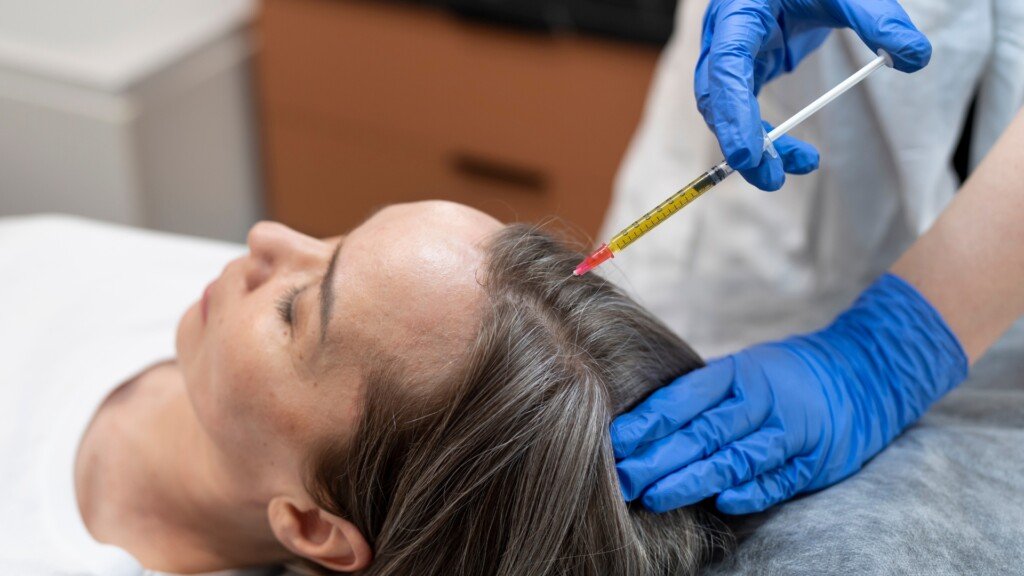
Platelet-rich plasma therapy uses your own blood to stimulate hair follicles. A small blood sample is drawn, spun in a centrifuge to concentrate the platelets, and injected directly into areas of the scalp experiencing thinning. Platelets are rich in growth factors — including PDGF, VEGF, and IGF — that signal dormant or miniaturising follicles to re-enter the active growth phase.
3 to 6×: The concentration of growth factors in platelet-rich plasma compared to normal blood: the biological driver behind PRP’s effect on hair follicles
How many PRP sessions do you need?
PRP is a course of treatment, not a single procedure. A typical protocol looks like this:
- Initial course: 3–4 sessions spaced 4–6 weeks apart — this is the active stimulation phase, where the bulk of follicle reactivation occurs.
- Maintenance: 1–2 sessions per year to sustain results once the initial course is complete.
- Assessment point: Most providers photograph the scalp at 3 and 6 months to measure progress objectively.
PRP Cost Reality Check Understanding the cost structure matters when evaluating the value of adding red light therapy to your protocol. Per session: $400–$1,500 depending on clinic, provider experience, and location (NYC averages $1,200+; Midwest typically $800). Initial course (3–4 sessions): $1,200–$4,000 in total. Annual maintenance: $600–$1,500 per year ongoing. PRP is not covered by insurance. The total multi-year investment can reach $5,000–$8,000+. A Growell Cap is a one-time purchase that replaces ongoing maintenance spending. See the full cost comparison below. |
Who is a good candidate for PRP?
PRP works best for androgenetic alopecia (male and female pattern hair loss) with active, miniaturising follicles — not for areas where follicles have been completely inactive for many years. The earlier treatment begins, the better the follicular response. It is also used effectively for telogen effluvium, alopecia areata (with physician guidance), and post-transplant recovery.
How Red Light Therapy Works at the Scalp Level
Red light therapy — also called low-level laser therapy (LLLT) or photobiomodulation (PBM) — uses specific wavelengths of red and near-infrared light, typically in the 630–670nm range, to stimulate biological activity at the cellular level. It does not heat tissue; it energises it.
When these wavelengths reach the scalp, they are absorbed by cytochrome c oxidase — a key enzyme in the mitochondrial respiratory chain. This triggers a cascade of effects directly relevant to hair follicle health:
- Increased ATP production: Cells have more energy available for the metabolically demanding work of growing hair.
- Improved blood flow: Red light causes vasodilation — widening of blood vessels — increasing the delivery of oxygen and nutrients to follicles.
- Extended anagen phase: LLLT has been shown to prolong the hair growth cycle’s active phase, reducing the proportion of follicles in the resting and shedding phases at any given time.
- Reduced scalp inflammation: Chronic low-grade inflammation around follicles is a significant driver of miniaturisation in androgenetic alopecia. Red light has established anti-inflammatory effects at the tissue level.
- Stem cell activation: Research has noted that red light therapy used alongside PRP may help activate circulating stem cells in the bloodstream — a mechanism that amplifies the regenerative effect beyond what either treatment achieves independently.
630–670nm: The clinically validated red light wavelength range for follicle stimulation — the range used by the FDA-cleared Growell Cap
Critically, photobiomodulation was designated an official Medical Subject Heading term by the National Library of Medicine in 2015, and the volume of peer-reviewed research validating its effects has grown substantially in the decade since. It is not fringe science — it is a recognised, FDA-cleared modality for hair loss treatment.
Why PRP and Red Light Therapy Work Better Together
PRP and red light therapy address hair loss through different but complementary mechanisms. PRP delivers a concentrated biological signal — growth factors that tell follicles to wake up and grow. Red light therapy optimises the cellular environment in which that signal operates. Combining them is not about doubling up on the same treatment; it is about addressing the problem from two distinct angles simultaneously.
The signal and the environment
Think of PRP as striking a match — an acute, targeted biological event. Red light therapy is the oxygen that keeps the flame burning. PRP’s growth factors stimulate follicle activity, but those follicles still need adequate blood flow, energy supply, and reduced inflammation to respond optimally. That is precisely what consistent LLLT provides in the weeks and months between clinic visits.
PRP Alone | PRP + Red Light Therapy |
Acute follicle stimulation at injection points | Acute stimulation + sustained between-session activation |
Effects may plateau between sessions | Consistent cellular support maintains momentum |
Relies on clinic visits for ongoing stimulus | At-home device continues treatment daily |
No anti-inflammatory support between visits | LLLT reduces scalp inflammation continuously |
Ongoing cost: $600–$1,500/year in maintenance sessions | One-time device cost; no recurring clinic fees for maintenance |
The clinical evidence for combination therapy
Multiple hair restoration specialists have documented improved outcomes when LLLT is integrated into PRP protocols. Dr Samer Muala, a board-certified physician specialising in hair restoration, notes that when patients use red light therapy consistently between PRP sessions, ‘We often use red light therapy post-transplant and alongside PRP. It improves healing and helps patients maintain results longer.’
In a clinical study published in the Journal of Clinical and Aesthetic Dermatology, 93% of participants showed improved hair count after 26 weeks of consistent LLLT use — with no adverse effects. A systematic review of photobiomodulation for androgenetic alopecia confirmed statistically significant improvements in hair density and shaft diameter across multiple randomised controlled trials.
When to use the Growell Cap relative to PRP sessions
Timing matters. For the best results from combination therapy:
- On PRP session days: Do not use the Growell Cap immediately before your PRP injection — you want clear, unobstructed scalp access for the procedure. Use it the evening after your session if comfortable, or resume the following day. The anti-inflammatory effect of LLLT can support post-injection recovery.
- Between sessions: Use the Growell Cap every other day (3–4 sessions per week), 20 minutes per session. This is the standard clinical protocol used in the pivotal LLLT studies.
- During maintenance phase: Once your PRP course is complete, continue with LLLT as your primary at-home maintenance tool. This is where the cost efficiency becomes most significant — ongoing LLLT sessions replace the need for some maintenance PRP visits.
- Long-term: Consistent LLLT use is required to sustain results. As Stanford Medicine’s Dr Rahman notes, ‘when the person stops applying red light, the effects stop.’ Build it into your routine rather than treating it as a short-term course.
The Cost Case for Adding Red Light Therapy to Your PRP Protocol
PRP is a significant financial commitment. Understanding how red light therapy fits into that investment — rather than adding to it — changes the conversation entirely.
Treatment | Per Session | Initial Course | Annual Ongoing |
PRP alone | $400–$1,500 | $1,200–$4,000 (3–4 sessions) | $600–$1,500/year ongoing |
LLLT alone (Growell Cap) | [INSERT PRICE] one-time | One purchase — no course needed | $0 ongoing cost |
PRP + Growell Cap | $400–$1,500 per PRP session | $1,200–$4,000 + device cost | Device replaces some maintenance PRP visits |
The key insight: PRP requires ongoing maintenance sessions to sustain results — typically one to two per year at $600–$1,500 each. Consistent red light therapy between and after your PRP course can reduce the frequency of those maintenance visits by sustaining follicle health at home, between appointments.
Over a three-year period, a patient who pairs their PRP course with a Growell Cap and reduces annual maintenance from two sessions to one will typically recover the cost of the device within the first year of the maintenance phase. After that, the cap becomes a net saving.
Why the Growell Cap Is Built for PRP Combination Therapy
Not all red light therapy devices are designed with professional hair restoration protocols in mind. When pairing with PRP, three things matter above all else: wavelength precision, full scalp coverage, and consistent wearability. The Growell Cap was built to deliver all three.
Clinical wavelengths, full scalp coverage
The Growell Cap delivers light at the clinically validated 630–670nm range across the full scalp, using a proprietary combination of laser and LED diodes to ensure uniform coverage not isolated zones. PRP injections are distributed across the scalp, and the supporting LLLT needs to reach the same areas. Devices with partial coverage undermine the entire premise of combination therapy.
FDA-cleared for men and women
The Growell Cap is FDA-cleared for hair loss treatment in both men and women — a designation that requires demonstrated safety and efficacy data, and that distinguishes it from the ‘FDA registered’ or unlabelled devices that dominate lower-price categories. When combining with a physician-guided PRP protocol, using a properly cleared device is not optional.
Designed for the real-world consistency combination therapy requires
PRP outcomes depend heavily on what patients do between clinic visits. A device that’s uncomfortable, conspicuous, or inconvenient will not be used consistently and inconsistent use produces inconsistent results. The Growell Cap’s lightweight design, soft fit, and 20-minute session time are not incidental features; they are the mechanism through which patients actually maintain the between-session activation that makes combination therapy work.
Modular and discreet by design
Growell’s removable light panel can be placed into most standard hats, allowing users to complete their sessions without the appearance of a medical device. For patients who want to integrate treatment into a daily routine without disruption (at home, at a desk, during commutes) this is a meaningful practical advantage over bulkier helmet-style devices.
Red Light Therapy with Other Hair Restoration Treatments
PRP is one of several treatments that benefit from red light therapy as a combination partner. If you are using or considering any of the following alongside your PRP protocol, the Growell Cap works synergistically with each:
- Minoxidil: LLLT and minoxidil address hair loss through different mechanisms: vasodilation and follicle cycle extension respectively and the combination is one of the most studied multimodal approaches in the field. Apply minoxidil after (not before) your red light session to ensure unobstructed light penetration to the scalp.
- Finasteride: For men using finasteride to reduce DHT-driven follicle miniaturisation, adding LLLT addresses the circulation and cellular energy side of the equation that finasteride alone does not cover.
- Hair transplantation: Red light therapy is increasingly integrated into both pre- and post-operative hair transplant care plans. Before surgery, it supports scalp conditioning. After surgery, it supports healing, follicle function in surrounding native hair, and graft success rates. Timing should always follow surgeon protocol.
- Collagen supplementation: Collagen provides structural support to the scalp dermis that houses hair follicles. Combining collagen supplementation with LLLT addresses both the nutritional and cellular sides of follicle health.
Summary
PRP is a meaningful investment in your hair — in time, money, and commitment. The question is not whether to protect that investment, but how. Red light therapy, used consistently between sessions with an FDA-cleared device, is the most evidence-backed way to maintain the follicle activation PRP creates and sustain your results over the long term.
Explore the Growell Cap and the clinical evidence behind it — and see why an increasing number of hair restoration physicians are integrating at-home LLLT into their PRP protocols as standard.
Maximise Your PRP Results with the Growell Cap
FDA-cleared red light therapy designed for full scalp coverage.
Used by patients and recommended by hair restoration physicians.
Explore the Growell Range of Hair Regrowth Products
FAQ: PRP and Red Light Therapy for Hair Growth
Can I use red light therapy after PRP treatments?
Yes. Red light therapy is non-invasive and commonly used after PRP to support healing, circulation, and follicle activity between sessions.
Does red light therapy interfere with PRP injections?
No. Red light therapy works at the cellular level and does not disrupt PRP injections or their effects.
When should I start using the GroWell Cap after PRP?
Many providers recommend starting red light therapy shortly after PRP treatments, following your physician’s specific guidance.
How often should I use red light therapy with PRP?
Most will benefit from consistent use every other day, depending on provider recommendations.
Is red light therapy safe for long-term use?
Yes. FDA-cleared red light therapy devices like GroWell have no known side effects and are designed for ongoing, long-term use without drugs or downtime.
Will red light therapy replace PRP?
No. Red light therapy complements PRP—it does not replace in-office treatments. Together, they offer a more comprehensive approach.