

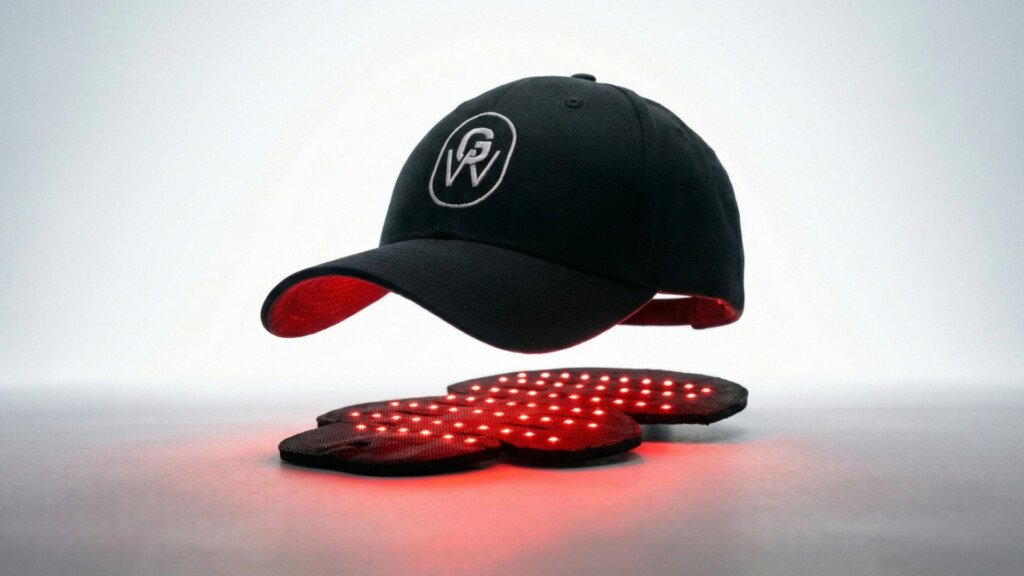
Science-First Hair Growth: More Light Diodes Doesn't Mean Better Results.
Why the red light therapy industry’s favorite marketing tactic is costing you money — and why the science tells a very different story.
Walk into any online marketplace today and you will find red light therapy hair regrowth devices competing on a single, seductive metric: diode count. “Our device has 272 diodes!” “Upgrade to 500 diodes!” “Maximum coverage with 1,000 laser points!” The implication is always the same — more must be better.
It’s a compelling pitch. It’s also fundamentally misleading. And if you’re making a purchasing decision based on diode count alone, you’re being sold a number — not a result.
The truth — grounded in clinical science, not marketing — is that red light therapy for hair regrowth, also referred to as low-level light therapy, low-level laser therapy, and clinically as photobiomodulation, works through a precise biological mechanism that responds to optimal dosage and wavelength, not raw quantity. There is a therapeutic sweet spot. Exceed it and you don’t get more hair. You get a higher bill.
“In photobiomodulation therapy, the question is never ‘how much light?’ — it’s always ‘the right light, at the right dose, delivered to the right tissue.’”
The Vitamin Analogy That Changes Everything
To understand why diode count is a red herring, consider something far more familiar: vitamins.
The Goldilocks Zone of Supplementation
Take Vitamin D. The recommended daily intake for most adults is around 600–800 IU. At that dose, you support bone health, immune function, and mood regulation. What happens when you take 10,000 IU every day? You don’t get 12× the benefit — you get toxicity. Nausea, kidney stones, and calcification of soft tissue.
The same principle applies to Vitamin C, Vitamin A, iron, zinc, and virtually every other micronutrient the body relies on. There is an optimal therapeutic window. Below it: insufficient effect. Within it: maximum benefit. Above it: diminishing returns at best — and potential harm at worst.
More is not better. Optimal is better. Every physician and pharmacist understands this. Every consumer should too.
Red light therapy for hair regrowth operates on precisely the same principle. The mechanism — photobiomodulation — involves specific wavelengths of light stimulating cellular activity in hair follicles. This only works when you deliver the right energy dose (measured in joules per square centimeter) at the right wavelength, typically in the 650–670nm range for hair follicle stimulation.
“Red light therapy is used for treating many conditions like acne, inflammation, anti-aging and thinning hair, but it’s not a case of ‘more is better,’” said Jonathn Graff, Director of Clinical Education at Apira Science, makers of the GroWell Cap for Hair Regrowth. “There’s an optimal ‘dose’ of wavelength and intensity of light for getting the best results for each application. It’s a bit like following a recipe: doubling the oven temperature doesn’t speed up the baking process, it ruins the cake.”
Cram in twice as many diodes without calibrating power, duration, and coverage geometry, and you haven’t doubled efficacy. You’ve doubled the component cost on the bill of materials — and passed that cost directly to the consumer. Your follicles don’t notice the difference. Your credit card does.
FACT: Doubling the diode count doesn’t double the result, but it can double the price tag.
What a Board-Certified Hair Restoration Physician Says:
“As a hair restoration specialist, I’ve seen the full spectrum of what’s marketed to patients — and the diode count arms race is one of the most persistent myths in this space,” said Dr. Samer Muala, a Board-Certified Physician and Hair Restoration Specialist. “My patients ask me all the time: should I get the device with more diodes? My answer is always the same: that’s the wrong question. The right question is whether the device has been clinically validated to deliver the correct therapeutic dose at the proven wavelength. Science doesn’t care how many diodes a device has. It cares about results. The GroWell Cap is the kind of device I trust, because it’s built around peer-reviewed evidence — not a spec sheet designed to impress shoppers.”
The Real Variables That Drive Hair Regrowth Results
When engineers design an effective photobiomodulation device, diode count is one consideration among many — and rarely the most important one. What actually determines clinical outcomes:
- Wavelength Precision: Hair follicle chromophores absorb most efficiently at specific red and near-infrared wavelengths. Off-target wavelengths don’t compensate — they’re simply wasted energy.
- Energy Density (Fluence): Measured in J/cm², this determines whether follicles receive a therapeutic signal. Too low: sub-therapeutic. Too high: inhibitory. The optimal window is specific and well-documented in the clinical literature.
- Scalp Coverage Uniformity: Even distribution across the scalp matters far more than raw diode count. Dead zones between diodes mean undertreated follicles — no matter how many diodes the device claims in total.
- Treatment Duration & Frequency: Clinical protocols define both session length and weekly treatment frequency. A device optimized for the right protocol outperforms a spec-sheet winner used incorrectly, every time.
Why the “More Diodes” Myth Persists
It’s simple psychology. Numbers feel tangible. “500 diodes” is a concrete, comparable figure — infinitely easier to market than “optimized fluence delivery across a clinically validated wavelength range.” Consumers comparison-shop on specs they can see, so manufacturers compete on specs they can inflate.
This creates a race to the top on a metric with limited relationship to outcomes — and a direct relationship to manufacturing cost. You pay more for diodes that deliver no additional therapeutic benefit. The device makers profit. Your follicles don’t notice the difference.
Several well-known brands have built their entire marketing identity around this false premise. The irony is that many of them cite the very clinical research that validates a completely different set of design principles — principles that the GroWell Cap was built around from day one.
GroWell Cap: Built Around the Science, Not A Marketing Spec Sheet
From the beginning, we asked a different question: what does the clinical literature actually say about optimal photobiomodulation for androgenetic alopecia? We engineered around that answer — not around a marketing narrative.
The result is our proprietary micro lens laser diodes paired with super luminescent LED light— a precision optical system that is FDA Cleared and ensures uniform light distribution across the entire scalp surface. Rather than relying on raw diode volume to hope for adequate coverage, our laser and LED lens array delivers consistent therapeutic fluence to every treatment zone. It’s the difference between a well-aimed therapeutic signal and a scatter-shot approach that wastes energy and your money.
And because we engineered for efficacy rather than the marketing kind of optics, we’ve achieved something our competitors with bulky helmets and rigid hard-shell hats cannot: a genuinely comfortable, soft cap form factor that patients actually wear consistently — which is, ultimately, the most important compliance variable of all. Plus, it’s the only red light therapy device for hair loss that also allows you to easily remove the light array and slip into most other hats, allowing the user to regrow hair their way. The best device in the world doesn’t work if it sits on a shelf. The unique design of the GroWell makes it a lot easier to avoid that.
At a price point well below most of our competitors, the GroWell Hair Regrowth Cap delivers more of what matters — clinically proven results — and less of what doesn’t: unnecessary diodes, unnecessary bulk, and an unnecessary price premium.
Proven. Twice. For Both Women and Men.
We don’t ask you to take our word for it. The GroWell Cap has been validated in two respected clinical studies — one for women and one for men — each conducted to the highest standard of scientific rigor, and each focused on a distinct patient population.
| Study for Women | Study for Men |
|---|---|
| 37% average increase in hair counts | 35% average increase in hair counts |
| Some participants: over 90% growth | Some participants: exceeding 90% growth |
| 100% of participants showed hair regrowth | 100% of participants showed hair regrowth |
| Double-blind, placebo-controlled; peer-reviewed; published in Lasers in Surgery and Medicine | Double-blind, placebo-controlled; peer-reviewed; published in Lasers in Surgery and Medicine |
Both studies were published in Lasers in Surgery and Medicine, the official journal of the American Society for Laser Medicine & Surgery — one of the most respected peer-reviewed journals in this field. These are the same rigorous standards used to evaluate pharmaceutical drugs. When a device earns that validation twice — for both women and men — it means something real.
Our results are consistent with, and in most cases exceed, those reported by the devices that have spread the false belief that more diodes equals more hair. The difference is that those claims rely on marketing. Ours rely on published, peer-reviewed science.
“More isn’t better. Optimal is better. And we have the peer-reviewed clinical data to prove exactly what optimal looks like.”
The Facts Matter When It Comes to Regrowing Hair
If you’ve been evaluating hair regrowth devices by diode count, you’ve been evaluating them by the wrong metric — one the industry invented because it’s easy to commoditize, not because it predicts outcomes.
The optimal dose of the right wavelength, delivered uniformly across the scalp, at a clinically validated frequency — that’s what grows hair. That’s what the science says. That’s what our two published, peer-reviewed clinical studies confirmed, independently, for both women and men. And that’s exactly what the GroWell Cap delivers: clinically proven results, superior scalp coverage through proprietary micro lens technology, genuine wearing comfort in a soft cap (not a bulky helmet or rigid hat), and a price that doesn’t ask you to pay for hundreds of unnecessary diodes.
Successful LLLT really boils down to two things:
- Using the optimal (not highest) dose of light for what you’re treating, and
- Consistent treatment over time.
Simply put, you can’t change what the dose of light does, only how it’s delivered.
More isn’t better. Optimal is better. Now you have the science to prove it.
Frequently Asked Questions About Red Light Therapy Diode Counts for Hair Growth
Because it’s easy to market. A number like “272 diodes” or “1,000 laser points” feels tangible and comparable to shoppers. Manufacturers compete on specs consumers can see, even when those specs have little bearing on clinical outcomes. It’s a classic case of marketing filling the vacuum where science should be.
They matter — but as one variable among several, not the defining one. What matters is whether the device delivers the correct energy dose (fluence) at the right wavelength, distributed uniformly across the scalp. A device with fewer, precisely calibrated diodes and proper optical design will consistently outperform a device with hundreds of diodes that hasn’t been engineered around clinical parameters.
The GroWell Cap operates in the clinically validated red light wavelength of 655nm, shown in peer-reviewed research to stimulate hair follicle activity. Not every wavelength of light triggers the same biological response — specificity here is everything, which is why our device is engineered to a precise specification rather than maximizing output across a broad, untargeted range.
Our proprietary laser micro lens and super luminescent LED system ensures that low-level light is distributed evenly across the entire scalp surface during each treatment session. Without uniform coverage, some follicles receive therapeutic doses while others sit in dead zones — regardless of how many total diodes the device has. Uniform delivery is what translates diode activity into consistent, scalp-wide results.
Yes — and this is an important distinction. Apira Science, makers of the GroWell products, conducted two separate double-blind, placebo-controlled clinical trials: one for women, one for men. Both were peer-reviewed and published in Lasers in Surgery and Medicine, the official journal of the American Society for Laser Medicine & Surgery. Both demonstrated 100% efficacy, with average hair count increases of 37% in women and 35% in men, and some participants experiencing growth exceeding 90%. More information about our studies can be found HERE.
It’s the gold standard of scientific clinical trial design — the same bar set for pharmaceutical drug approvals. “Double-blind” means neither the participants nor the researchers evaluating results knew who was receiving the active treatment. “Placebo-controlled” means there was a comparison group using an inactive device. This design eliminates both participant bias and observer bias, making the results genuinely reliable.
Our published results are consistent with — and in most cases better than — those reported by competitors who have built their marketing around high diode counts. The critical difference is that our results come from peer-reviewed, published clinical trials. Many competitors cite third-party studies that weren’t conducted on their specific device, or rely on general photobiomodulation research to imply efficacy without direct clinical validation of their own product.
Yes. The GroWell Cap is FDA-cleared for hair regrowth, meaning it has met the regulatory standard required for medical devices making therapeutic claims in the United States.
Both clinical studies used a 16-week treatment protocol, with participants using the device every other day. Hair count improvements were measured at the end of that period. Results will vary by individual, but the clinical data gives a clear and well-documented benchmark: meaningful, measurable regrowth within four months for the overwhelming majority of users.
Because we didn’t engineer unnecessary components into the product. When you strip away the excess diodes that don’t contribute to clinical outcomes, the inflated spec counts, and the rigid helmets and bulky housings built to justify premium prices, what remains is a precisely designed therapeutic device. We pass that engineering discipline on to the consumer in the form of a lower price — without compromising the results that two peer-reviewed studies have validated.
Ease of use in a busy lifestyle. The most effective device is one patients actually use consistently over a 16-week protocol. Bulky helmets are uncomfortable, conspicuous, and impractical for daily life. The GroWell Cap’s soft, lightweight design can be worn hands-free during normal activities, which significantly improves the likelihood that users complete the full treatment course — and see the full results. PLUS, it’s the only LLLT device where the light panel can be easily removed and placed in most other hats, allowing the user to regrow hair with their own style.