

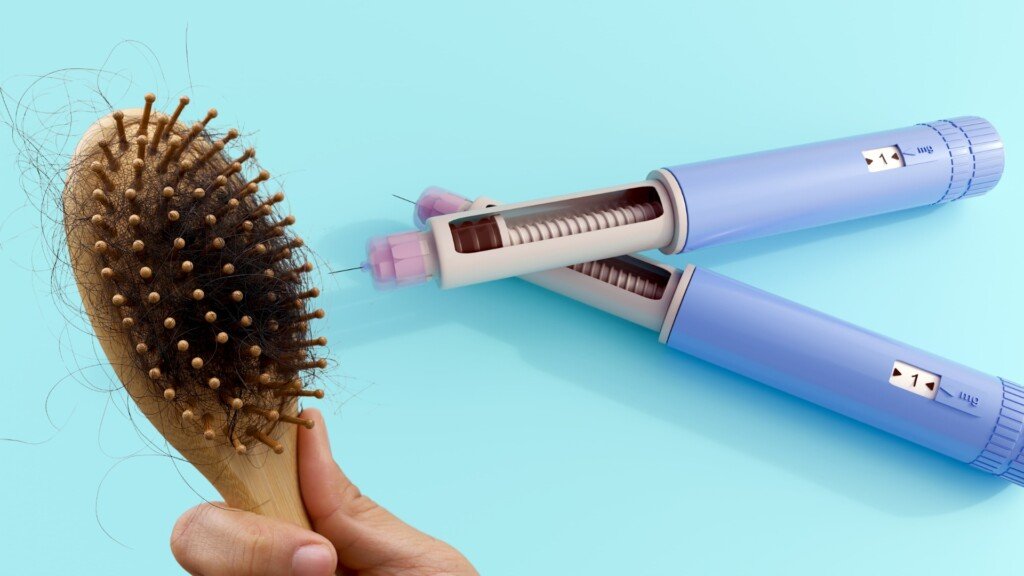
GLP-1 medications like semaglutide (Ozempic, Wegovy) and tirzepatide (Mounjaro, Zepbound) have transformed how millions of people approach weight loss and metabolic health. But as these medications have surged in popularity, a frustrating side effect has been showing up in mirrors and shower drains everywhere: thinning hair.
If you’ve noticed more shedding a few months into your GLP-1 journey, you’re not imagining it — and you’re definitely not alone. GLP-1 hair loss is real, it’s common, and in most cases it’s temporary. There are real, evidence-based ways to support hair regrowth, and one of the most promising, non-invasive options is red light therapy. Here’s what’s actually happening, and how to get your hair back on track.
Why GLP-1 Medications Can Cause Hair Loss
First, an important reassurance: in most cases, the medication isn’t directly attacking your hair follicles. The far more common culprit is a condition called telogen effluvium (TE) — a temporary, diffuse shedding that happens when the body goes through a significant stressor.
Rapid weight loss is exactly that kind of stressor. When you lose weight quickly, a larger-than-normal share of your hair follicles can be pushed prematurely into their resting (telogen) phase. A few months later, those hairs shed all at once, which is why the timing can feel so confusing. Most people notice increased shedding roughly two to four months after starting a GLP-1 or after a period of fast weight loss, reflecting the natural delay built into the hair growth cycle rather than an instant reaction to the drug.
How to tell it’s GLP-1 hair loss: telogen effluvium shows up as even, all-over thinning across the whole scalp — more hair in the shower, on your brush, or on the pillow. That diffuse pattern is different from alopecia areata, which causes distinct bald patches. If your shedding is patchy rather than spread out, it’s worth asking your clinician to rule out other causes.
A few factors make GLP-1 hair loss more likely:
- Speed and amount of weight loss. Tirzepatide and higher-dose semaglutide produce the most dramatic weight loss and have been most frequently linked to shedding in early reports.
- Nutritional shortfalls. Because GLP-1s suppress appetite, it’s easy to fall short on protein, iron, zinc, and other nutrients your follicles depend on. These deficiencies are well-recognized triggers for telogen effluvium.
- Sex differences. Women appear to be disproportionately affected in the data so far.
Researchers have long suspected a more direct, genetic connection between GLP-1 use and hair loss, separate from the stress-and-nutrition pathway above — and a September 2026 study has now provided the first evidence for one. Led by NYU Langone Health and published in the Journal of Investigative Dermatology, the study found that men who carry gene variants for androgenetic (pattern) hair loss had about a 7% higher relative risk of hair loss while using GLP-1 drugs such as Ozempic, Wegovy, and Zepbound.
The most encouraging part: telogen effluvium is typically reversible. Once the trigger settles and your body adjusts, follicles generally cycle back into a growth phase. The question most people have is simply: how do I help that happen faster and more fully?
How to Stop GLP-1 Hair Loss: Support Your Body First
Before any device or treatment, the groundwork matters. These steps address the root trigger:
- Prioritize protein. Aim to hit adequate daily protein, since hair is made largely of protein and it’s one of the easiest things to under-eat on a GLP-1.
- Mind key nutrients. Iron, zinc, and vitamin D are common shortfalls. Ask your clinician about checking your levels rather than guessing or over-supplementing (more biotin, for example, isn’t a proven fix and can interfere with some lab tests).
- Slow down if you can. Where appropriate, a more gradual pace of weight loss puts less stress on the hair cycle.
- Be gentle. Skip tight styles, harsh heat, and aggressive brushing while your hair recovers.
Medical options like topical minoxidil are also commonly used to nudge follicles back into the growth phase, and some people explore in-office treatments such as PRP. These are worth discussing with a qualified provider.
But there’s one at-home option that’s earned a lot of attention for being effective, non-invasive, easy to stick with and proven by real scientific research to regrow hair: red light therapy.
Red Light Therapy: The Science-Backed Way to Support Regrowth
Red light therapy — known clinically as low-level light therapy (LLLT) or photobiomodulation (PBM) — uses specific wavelengths of red and/or near-infrared light to stimulate activity at the cellular level. Applied to the scalp, the light is absorbed by the hair follicles, where it’s been scientifically proven to boost cellular energy production (ATP), improve local circulation, reduce inflammation, and help shift follicles back into and extend their active growth (anagen) phase.
This isn’t a fringe idea. Low-level light therapy was the first device-based treatment cleared by the FDA for pattern hair loss (back in 2007), and it sits alongside minoxidil and finasteride as a medically recognized option. A large body of randomized, placebo-controlled trials and meta-analyses has found that LLLT can meaningfully improve hair growth in cases of androgenetic alopecia.
Watch the Fox News Report: GroWell Red Light Therapy Cap Can Regrow Hair Lost During GLP-1 Usage
A quick note on honesty, because it matters: most of the strongest clinical evidence for red light therapy is in androgenetic (pattern) hair loss, while GLP-1 shedding is usually telogen effluvium. The two aren’t identical. What red light therapy does exceptionally well is create a healthier scalp environment and improve cellular function in order to accelerate your follicles to do what they do, only better and faster. It reduces shedding and speeds the hair regrowth process. It pairs naturally with fixing the underlying nutritional and weight-loss triggers, rather than replacing that work.
It’s also painless, drug-free, has an excellent safety profile, and requires no downtime — which is why so many people choose it as their go-to at-home hair regrowth tool.
Why the GroWell Red Light Therapy Cap Stands Out
If you’re going to invest in red light therapy, the device should make consistency effortless — because consistency is what drives results. That’s exactly where the GroWell Red Light Therapy Cap for hair growth shines.
The GroWell cap delivers full, even red light therapy coverage in a hands-free design that is convenient and comfortable to wear. A few of the things that make it a standout choice:
- Truly portable and discreet. Lightweight, rechargeable, and comfortable enough to make it a habit you’ll actually keep. PLUS, our light insert is easily removed and placed into most other hats – allowing you to regrow hair without the stigma of those bulky helmets.
- Clinically relevant wavelengths. GroWell uses 655nm red light, which is the optimal wavelength supported by LLLT research for hair growth.
- Full-scalp coverage. With proprietary micro-lens laser™ and S-LED red light diodes the GroWell covers every area of the scalp with the optimal dose of light — no missed spots.
- Short, simple sessions. 25 minutes every other day does the trick — wear it while you read, work, commute, walk the dog or just simply relax.
- Built to last. Backed by a 12-month money-back guarantee and two-year warranty.
The whole point is to keep it simple. The best regrowth device is the one you’ll use multiple times per week without thinking about it — and that’s what the GroWell cap is designed for.
“As a board-certified obesity medicine specialist, I have seen many patients shed pounds and wonder where their hair went,” said Dr. Samer Muala, a renowned hair growth expert and founder of Him & Hair. “GroWell solves this with effective stimulation of follicles while overcoming the obstacle of compliance- it’s easy to use and can be incorporated into your daily routine.
What to Expect and How to Use It
Hair grows slowly, so patience is part of the process. Most people using red light therapy should think in terms of three to four months of consistent use before judging results, with shedding often slowing first and visible thickening following later. In the Apira Science studies, 100% of participants receiving treatments regrew hair within 4 months, so that’s that a realistic goal to achieve for most users. For best results:
- Use the cap consistently on the schedule recommended for your device.
- Keep supporting your body with protein, key nutrients, and gentle hair care. Taking supplements, such as GroWell’s all-natural formulas, can also help improve outcomes for some people.
- Track progress with monthly photos in the same lighting — change is easier to see in pictures than in the mirror.
Fuller, Healthier Hair Is Just Around the Corner
Hair loss can be one of the most discouraging parts of a GLP-1 journey, but it’s usually temporary — and you don’t have to wait it out passively. By addressing the root triggers and adding a clinically supported tool like red light therapy, you can actively encourage your hair back to fuller, healthier growth faster. The GroWell Red Light Therapy Cap makes that as simple as putting on a hat.
Your weight-loss progress shouldn’t have to come at the cost of your hair. With the right support, you can keep both.
This article is for general informational purposes only and is not medical advice. Hair loss can have many causes, and individual results vary. Do not start, stop, or change any medication — including a GLP-1 — without consulting your prescribing clinician. Talk to a qualified healthcare provider about the right approach for you.